Today, we operate in what is termed a burning digital economy, with the rapid evolution of technology working against the limited budgets and fewer in-house experts that small businesses and startups typically must contend with. Over 40% of small and medium enterprises globally admit lacking essential digital skills for successful transformation. Without the right set of tools and digital marketing strategy, ensuring relevance day by day becomes ever harder.
The good thing is, when small businesses successfully marry technology, platforms, and automation, they can one-up their competitors and take on industry leaders. Smart businesses using smart tools are thrice as likely to experience customer growth. Almost 85% of small businesses have claimed that productivity and efficiency improved once they started using digital solutions. If it is a startup or an established SME, just the right set of tools can very much push their presence forward, lead engagement, and sustain growth.
Discovering Customer Data to Better Connect
The first step to productive customer relationships is getting clean data in place. Every interaction, purchase, and preference carries clues about what motivates a buyer to purchase. Small businesses can use the data that is made available by these interactions to create space for substantive engagement, helping to convert sporadic buyers into customers for life. Organisations that personalise their outreach based on prior actions are 2.5 times more likely to improve customer lifetime value.
When a local organic skincare brand began to analyse customer preferences based on a rudimentary CRM, it was evident that simply sending timely restock reminders had increased repeat purchases by 42%. When you become a savvy user of structured data, your business's marketing becomes a conduit for relationships rather than an expensive push for "one-time sales".
Customer data indicates who buys, why they buy, how often they buy, and what's likely to happen next. Recognising purchase patterns across a channel using custom data structures allows small teams to identify their most active users, time campaigns, and retain more customers without spending thousands on unreliable, aggressive levers. For a business that is factoring more digital marketing services for small business, structured customer data is a user's instrument to solidify long-term ROI.
The Right CRM: HubSpot vs. Zoho vs. Salesforce Essentials
Choosing the right CRM for day-to-day operations is more important than simply checking off features. Here’s a quick overview of the three most-used CRM platforms in small teams and startups:
Best for: Small teams that want a simple place to begin. Strengths: A free, basic version, an easy-to-use interface, and excellent marketing workflows. This makes it an excellent choice for novice users who want to quickly get started without requiring extensive technological knowledge.
Best for: Budget-conscious startups that need something flexible. Strengths: Inexpensive subscription pricing; modular (scalable) capabilities, and solid selling and service capabilities. This is a popular choice for firms that are growing by phases—e.g., a design studio that expands from two employees to ten employees.
Best for: Growing businesses with increased layers of complexity. Strengths: Highly customisable, good reporting features, and the ability to expand easily. Service-led businesses and companies with larger sales pipelines will find this option most usable.
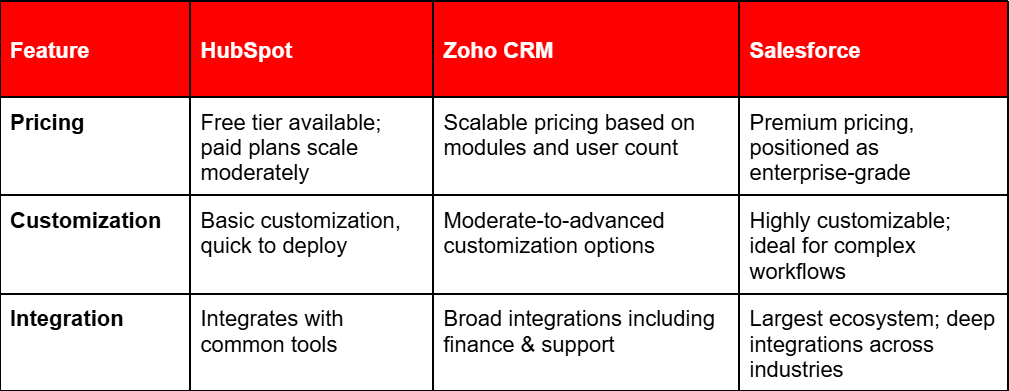
At a glance:
Pricing: Hubspot has a free tier, Zoho has a scalable pricing structure, and Salesforce is a high-end product.
Customisation: Salesforce is on top, followed by Zoho. HubSpot is simpler, but one can view it as faster to deploy.
Integration: All three platforms integrate with common tools, but the size and the reach of Salesforce's ecosystem are far larger.